
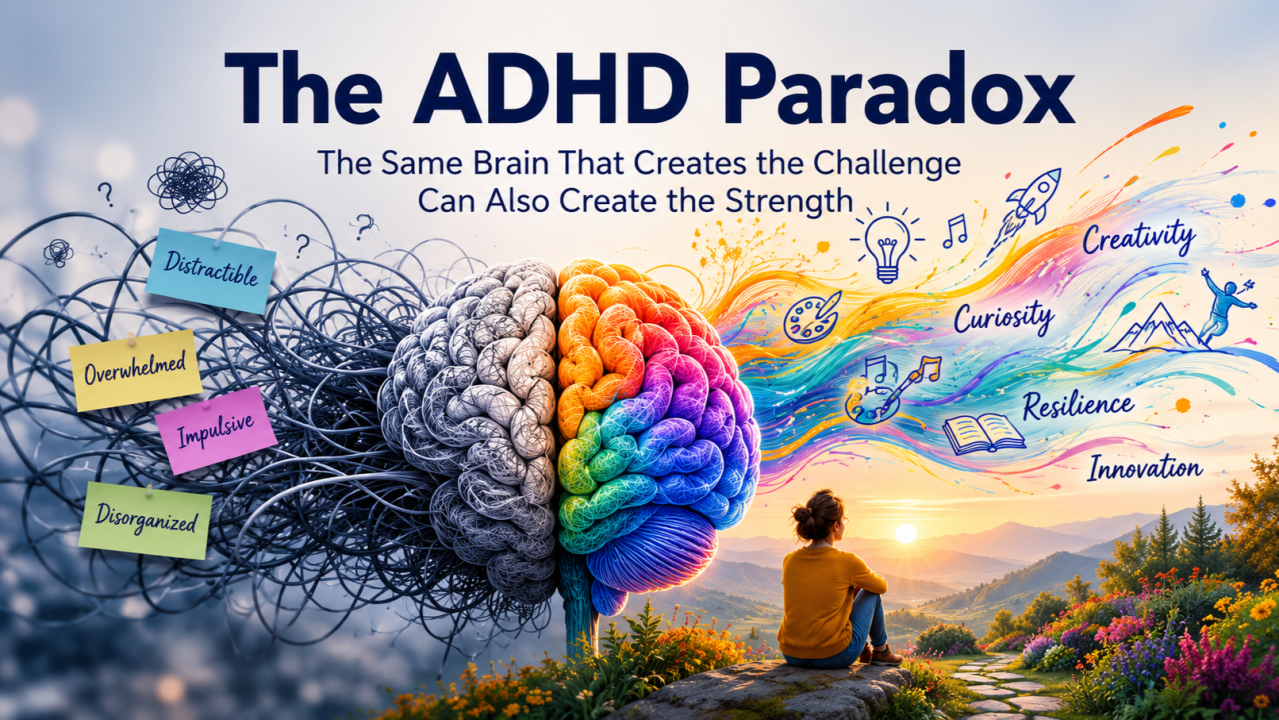
The ADHD Paradox: The Same Brain That Creates the Challenge Can Also Create the Strength
When we think about the origins of what is currently known as ADHD, the initial focus was entirely upon the problematic aspects of ADHD in children, boys to be specific. ADHD was defined through the observation of hyperactive little boys that were “Dennis the Menace” tornadoes in the classroom and at home, couldn’t sit still, didn’t pay attention, jumped on the furniture, and raced around, creating chaos in the classroom and at home. ADHD was defined in terms of the perspective of the adult onlooker – viewing the child’s behavior as disruptive and undesirable. We’ve now, very slowly, come to define ADHD as a lifelong condition and, after years of effort, a committee is soon to publish adult ADHD guidelines, still defining it from the point of view of the onlooker – as a set of “inconvenient truths” (to borrow a phrase from Al Gore) – as a condition that gets in the way of daily functioning at home, at school, or at work. Defining ADHD in this way means that there’s no up-side to it – it’s purely a disorder that is defined as a disability. And while ADHD can certainly be disabling, it’s more complicated than that. You can describe any type of brain in purely negative terms. My husband, a retired astrophysicist, could also be defined by his difficulties in dancing, poetry writing, and singing. And if you only looked at those abilities, he would certainly qualify for a disability. But he had the good sense to head in a direction that was a good match for his tremendous strengths in science, mathematics, and analytical thinking.
I once gave a tongue-in-cheek presentation on “Attention Excess Disorder” characterized by:
- Always knowing where your keys are
- Never forgetting why you walked into a room
- Starting tasks before the deadline
- Finishing what you started
- Having one browser tab open
- Knowing what day it is
- Reading an email once and actually responding to it
- Never hyperfocusing on something completely irrelevant
Those with AED are great organizing and getting things done. And it’s always convenient to have someone with AED in any group. There was a woman in a book group I once belonged to that definitely had AED – she always knew what next month’s book was and who was hosting – on the flip side, she rarely had insightful comments about the books we read. Setting the rules and then following them was her strength.
Whether we see ADHD as a disorder or a super-power, we are engaging in simplistic thinking. As clinicians, our goal is to help people impacted by this set of traits that we currently call “ADHD” lead their best life. The question is, what do we need to understand about each person that comes to us for help?
First, we need to understand the complexity of each individual. As Hans Leukas-Teuber, MIT professor considered to be the father of the field of neuropsychology, said, “Our brains are as different as our faces.” In order to understand the person coming to us for help, the initial question may be, “Do I have ADHD?” but our task, as the expert, is to shift the question to what is true about me, what is unique about me, what do I care most about, and what is getting in the way of leading a productive and satisfying life? ADHD doesn’t live in a box by itself, no matter how we try to simplify it. Each person may have some subset of ADHD traits, and those traits each exist along a continuum. The clinician must ask questions such as how much does the individual sitting in my office struggle with time blindness, internal distractibility, poor working memory, disorganization, low motivation, impulsivity, emotional dysregulation, etc., etc., while at the same time asking about their strengths.
Not surprisingly, many with ADHD haven’t been made as aware of their strengths as of their challenges. And there is so much variety. For example, some with ADHD have a high energy level and are athletically gifted, while others have developmental coordination disorder (common among those with ADHD, but not commonly considered) and low energy level. Some are artistically or musically talented. Some are extroverts that go into fields such as entertainment, sales, or politics. Others are introverted or on the autism spectrum and thrive best in an environment that doesn’t require much interpersonal interaction. In other words, it’s complicated! We need to stop over-simplifying and putting people into categorical boxes. The more I learn about our complicated brains the more I imagine colorful, interwoven strands of traits and tendencies that come together in an endless variety of patterns.
The balance is found not by deciding whether ADHD is a “disorder” or a “superpower,” but by recognizing that the same underlying characteristics can be advantageous in one context and disabling in another. The metaphor I use is that we each need to “plant ourselves in the right garden” where we can thrive. As clinicians, one of the important things we can bring to the process of treatment is helping people understand the gardens in which they can thrive.
This framework is more useful for clinicians and more compassionate for people with ADHD.
The paradox of the ADHD brain
Consider novelty seeking.
A strong need for novelty can mean:
- boredom with repetitive work
- difficulty initiating routine tasks
- abandoning projects once the excitement fades
But that same characteristic can support:
- curiosity
- exploration
- entrepreneurship
- willingness to try something different
- rapid adaptation to change
Similarly, impulsivity can lead to poor decisions and interruptions. But in some circumstances, it can also mean rapid action, spontaneity, and willingness to take a calculated risk. A strengths-based ADHD framework makes exactly this point: characteristics such as impulsivity, high energy, distractibility, and hyperfocus can function as either challenges or advantages depending on context.
The key issue is not the trait in isolation. It’s the interaction between the trait and the environment. ADHD characteristics become strengths when the environment allows them to work to the person’s advantage, and become impairments when the environment demands the opposite.
There is actually some empirical support for this more nuanced view. A 2024 study of 694 adults found that ADHD traits were positively associated with hyperfocus, cognitive flexibility, and sensory-processing sensitivity, although not all proposed ADHD strengths showed positive associations.
And research on creativity illustrates the same complexity: ADHD research has found some evidence for greater divergent thinking, but that doesn’t translate into a blanket finding that people with ADHD are simply “more creative.”
The strengths don’t erase the disability.
And the reverse is also true:
The disability doesn’t erase the strengths.
Both can be true at the same time.
Perhaps the most important distinction is potential versus performance.
Someone can be extraordinarily imaginative but unable to translate ideas into completed projects.
Someone can be highly empathic but unable to consistently remember to return a friend’s call.
Someone can be brilliant in a crisis but unable to keep up with routine administrative responsibilities.
Someone can become completely absorbed in a subject they love but be unable to sustain five minutes of attention on something they find meaningless.
These aren’t contradictions.
They’re characteristic of a brain whose performance is often highly dependent on interest, stimulation, novelty, urgency, and personal meaning.
So where is the balance? Our work as clinicians is to help our clients to:
- Know their ADHD profile — what reliably becomes difficult and what reliably engages them.
- Build structure in their life so that executive-function weaknesses don’t have to be overcome through willpower alone.
- Plant themselves in the right garden – the circumstances in which their ADHD characteristics become advantages.
- Look for ways to accommodate the areas in which the environment imposes demands that are genuinely difficult for them.
To summarize, the task before an individual with ADHD is to learn how their brain works, then build a life that allows its strengths to emerge while protecting them from its vulnerabilities.
ADHD is neither simply a deficit nor simply a gift. It is a different pattern of cognitive and behavioral characteristics that creates both vulnerabilities and possibilities. The challenge is to understand which characteristics create impairment, which can become strengths, and what environmental conditions allow those strengths to emerge. And our task as clinicians is to lead our clients on this potentially exciting and fulfilling journey.
References:
Schippers, L. M., Greven, C. U., & Hoogman, M. (2024). Associations between ADHD traits and self-reported strengths in the general population. Comprehensive Psychiatry, 130, Article 152461. https://doi.org/10.1016/j.comppsych.2024.152461
Hoogman, M., Stolte, M., Baas, M., & Kroesbergen, E. H. (2020). Creativity and ADHD: A review of behavioral studies, the effect of psychostimulants and neural underpinnings. Neuroscience & Biobehavioral Reviews, 119, 66–85. https://doi.org/10.1016/j.neubiorev.2020.09.029