
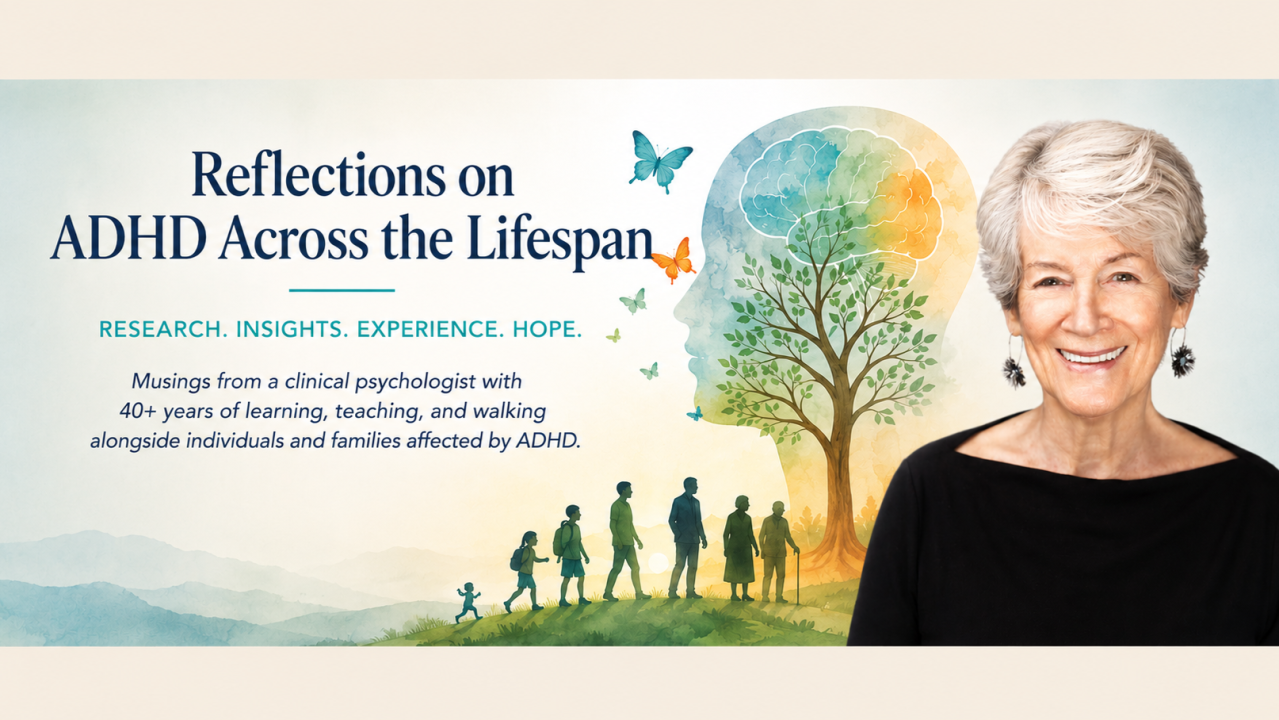
Welcome to the musings of a mind that has been thinking about ADHD for more than four decades.
When I began my career, I never imagined that helping people with ADHD would become my life’s work. It wasn’t something I planned—it found me. Before long, I was completely captivated by the complexity of ADHD and, even more importantly, by the remarkable people living with it.
Part of that passion comes from my own lived experience. ADHD runs deep in my family. I am the granddaughter, niece, sister, mother, and grandmother of people with ADHD. Alongside ADHD, our family has experienced many of its frequent companions: autism, dyslexia, bipolar disorder, generalized anxiety, nicotine addiction, substance use disorder, and eating disorders. (I’m probably forgetting a few!)
But that’s only part of the story.
Among these same family members are a physician, a plant geneticist, an editor, successful business owners, an interpreter for the deaf, a computer scientist, and yes—a clinical psychologist (that would be me). Living in a neurodiverse family has taught me something that research continues to confirm: ADHD rarely tells the whole story. Challenges and strengths often coexist in surprising and inspiring ways.
Over the course of my career, our understanding of ADHD has changed dramatically. We have gone from believing it affected only young hyperactive boys to recognizing that ADHD affects people of every gender, persists throughout the lifespan, and presents in countless different ways. As our knowledge has expanded, we’ve also come to appreciate its extraordinary complexity. Today, it sometimes feels easier to list the conditions not associated with ADHD than those that commonly occur alongside it. And perhaps most encouraging of all, we’re finally beginning to give as much attention to the strengths, creativity, resilience, and innovation that so often accompany ADHD as we have to its challenges.
I’ve also had a front-row seat to sweeping changes in the field of mental health. Early in my career, psychiatry shifted from the era of psychoanalysis to one dominated by psychopharmacology. Today, I believe we’re standing at the edge of another transformation.
Many clinicians continue to rely heavily on the DSM’s symptom-based definitions of ADHD, while others are asking whether those definitions are sufficient to capture the richness and complexity of neurodevelopmental differences. Unlike virtually every other medical specialty, psychiatry relies on a diagnostic manual that changes only periodically. In most areas of medicine, new discoveries are incorporated rapidly into clinical thinking. Research is published, evidence accumulates, and practice evolves. ADHD deserves that same spirit of curiosity, flexibility, and willingness to rethink what we thought we knew.
That’s what my reflections will be about.
Some will explore new research. Others will challenge long-held assumptions. Many will draw on clinical experience, conversations with colleagues, and lessons I’ve learned from thousands of individuals and families over the years. My hope is that these essays will spark curiosity, encourage thoughtful discussion, and, above all, help us better understand the many ways ADHD shapes lives across the lifespan. And all of my musings and clinical experience, alongside some of the top clinicians in the field will be incorporated into the classes, courses, and case conferences that will be offered through ILAT – the Institute for Lifespan ADHD Training. My intention is to build a community including all those that are hungry to learn more about ADHD and how to use that knowledge to improve the lives of those with ADHD.
I invite you to join me on this exciting journey. Subscribe to my newsletter and join the ILAT community (www.ilat.org/join-now/) where we can all learn from one another.
Kathleen Nadeau, PhD