
If ADHD diagnosis is going to evolve, ADHD education must evolve with it.
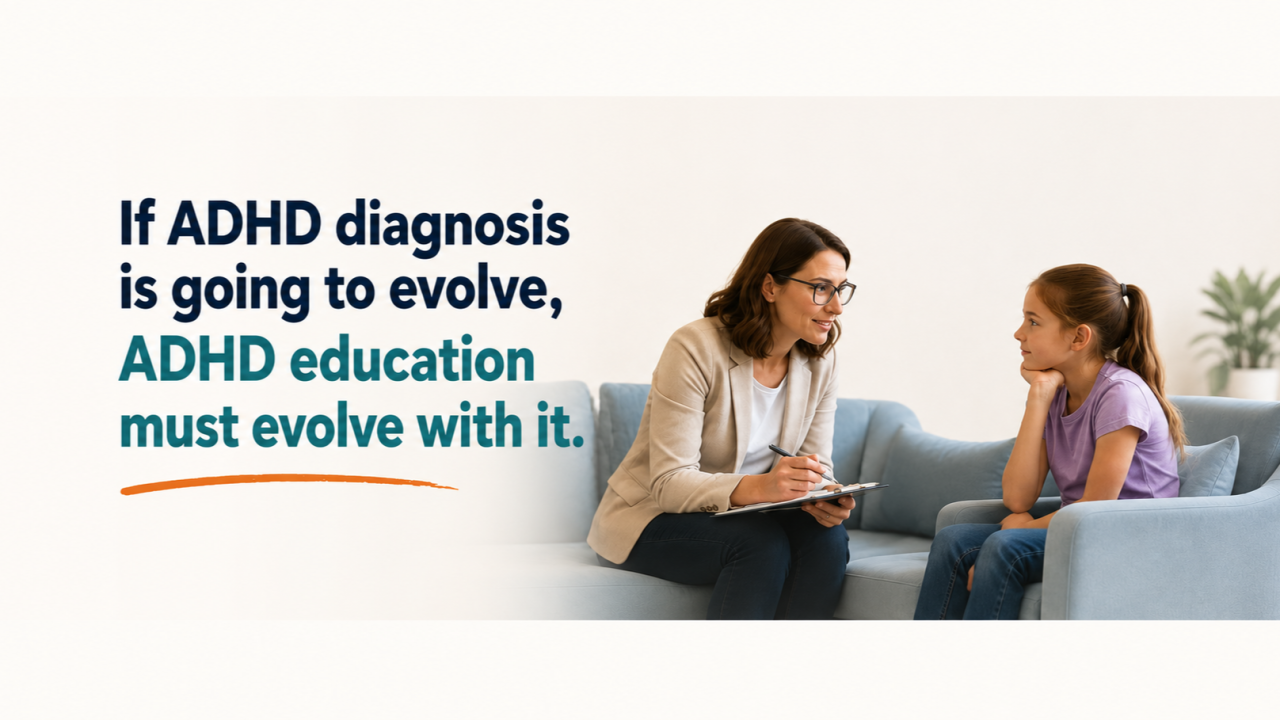
Sticking to the DSM-5 without nuance or understanding leads to frequent misdiagnosis in all but the most obvious cases. For example, I was contacted recently by a mother who wrote: My husband and I both have diagnosed ADHD. We are sure our 8-year-old daughter has ADHD as well, but when we took her for an assessment the clinician that we spoke to said that she didn’t qualify for an ADHD diagnosis. Although her behavior at home was consistent with an ADHD diagnosis, her teacher did not report problems at school. As a result, he said, she could not have ADHD, and that the problem must be related to our relationship to our daughter and our home environment.
Now, to be fair to that professional, he was only doing what he was taught to do – to follow the DSM-5 guidelines. Those guidelines state that to make an ADHD diagnosis there must be:
1) Several inattentive or hyperactive-impulsive symptoms present in two or more settings (e.g., at home, work, school).
And…..
2) Clear evidence that the symptoms interfere with, or reduce the quality of, social, academic, or occupational functioning.
What that clinician clearly didn’t know is that this pattern of functioning well at school and being emotionally reactive, oppositional and argumentative at home is very common among elementary school aged girls. Why? Because girls try harder to mask and compensate for their symptoms. They want to fit in with other girls and so they mask. They want to please their teacher and so they compensate to the best of their ability. Once they arrive home, their capacity to compensate has been thoroughly depleted and the mask comes off with a roar. The slightest frustration, the slightest demand and the girl with ADHD who’s been “perfect” all day at school responds with crying, screaming and argument. But this information isn’t found in the DSM. It is my intention that such information will be found within courses at the Institute for Lifespan ADHD Training (ILAT).
Clinicians need more than the ability to recognize and count DSM criteria. It’s important to understand that there is nothing inherently different between a child that manifests five symptoms and one that demonstrates six. Instead, clinicians need to understand how ADHD presents differently across development, gender, cognitive ability, environment, and life circumstances. They need to know how ADHD interacts with anxiety, depression, learning differences, sleep, trauma, autism, and other conditions. They need to understand the lived experience of those with ADHD. And they need to be able to translate knowledge into practical, individualized treatment.
Information about ADHD is everywhere. Knowing how to apply that information is not.
That is the gap that ILAT intends to bridge.
A Call for Change
The next generation of ADHD diagnosis should not only count symptoms or tick boxes on a questionnaire. Those have their place, but for accurate diagnosis the exploration should be more developmental, more dimensional, more individualized, and more clinically useful.
We should retain the DSM’s value as a common diagnostic framework while recognizing its limitations. Beyond asking whether a person has enough symptoms to qualify for a label, we should ask what those symptoms mean in the context of that person’s development, environment, strengths, challenges, and life.
We need to move:
- From symptom counting to clinical understanding
- From categorical to dimensional thinking
- From current behavioral “snapshots” to developmental histories
- Fr0m deficits to strengths as well as challenges
- From multiple labels to an integrated formulation
We need to go beyond asking “Does this person have ADHD?” and ask, “What does ADHD look like in this person, how has it shaped their life, and what will help them thrive?”
The DSM can help us answer the first question. Clinical expertise must answer the rest.
Join us at the ILAT Global ADHD Summit this October and after the Summit we hope you’ll become a member of the ILAT community – a space where clinicians can share cases, share diagnostic and treatment dilemmas, learn from the best and from one another.
There’s a revolution afoot to improve ADHD diagnosis and treatment! Join us!