
I am often asked why there is such a strong — and growing — interest in ADHD today.
I’ve specialized in ADHD for decades. More than 25 years ago, I remember talking with one of my editors about the public’s seemingly endless thirst for books about ADHD. She assumed it would be a short-lived phenomenon — a wave of interest that would eventually pass.
Instead, interest in ADHD has grown decade after decade.
We need to ask ourselves why.
Some people with ADHD are so profoundly impacted that their differences are evident in almost any environment. These are the ADHDers with an intense need for movement, a craving for stimulation, a low tolerance for boredom, and an urgency to seek what is new and exciting. They have always been among us, and much has been written about whether these traits represent a disability — or a mismatch between a particular kind of brain and a particular kind of environment.
They are the “hunters in a farmer’s world,” as Thom Hartmann described many years ago. They are often the explorers, adventurers, entrepreneurs, innovators, and risk-takers — the people who hear E. E. Cummings’ invitation: “…there’s a hell of a good universe next door; let’s go.”
And then there are the quieter ADHD brains — the “inattentive” types who may appear calm on the outside while living in a rich, constantly active internal world.
One profoundly inattentive teenage girl with ADHD once told me that she always had an ongoing novel playing in her mind, complete with complex characters and evolving storylines. The world inside her head was simply more compelling than much of what was happening around her.
These are the poets, the observers, the dreamers — the people who notice what many of us miss as we rush through daily life.
Our world needs all of these different kinds of minds. Without them, we would be less creative, less innovative, and less human.
But what about the rest of us?
Most people with ADHD are not constantly seeking the next adventure or writing novels in their heads. Many — and seemingly an increasing number — are simply struggling to focus, finish tasks, manage competing demands, and decide what deserves their attention from one moment to the next.
Why?
Why are so many people struggling just to keep up?
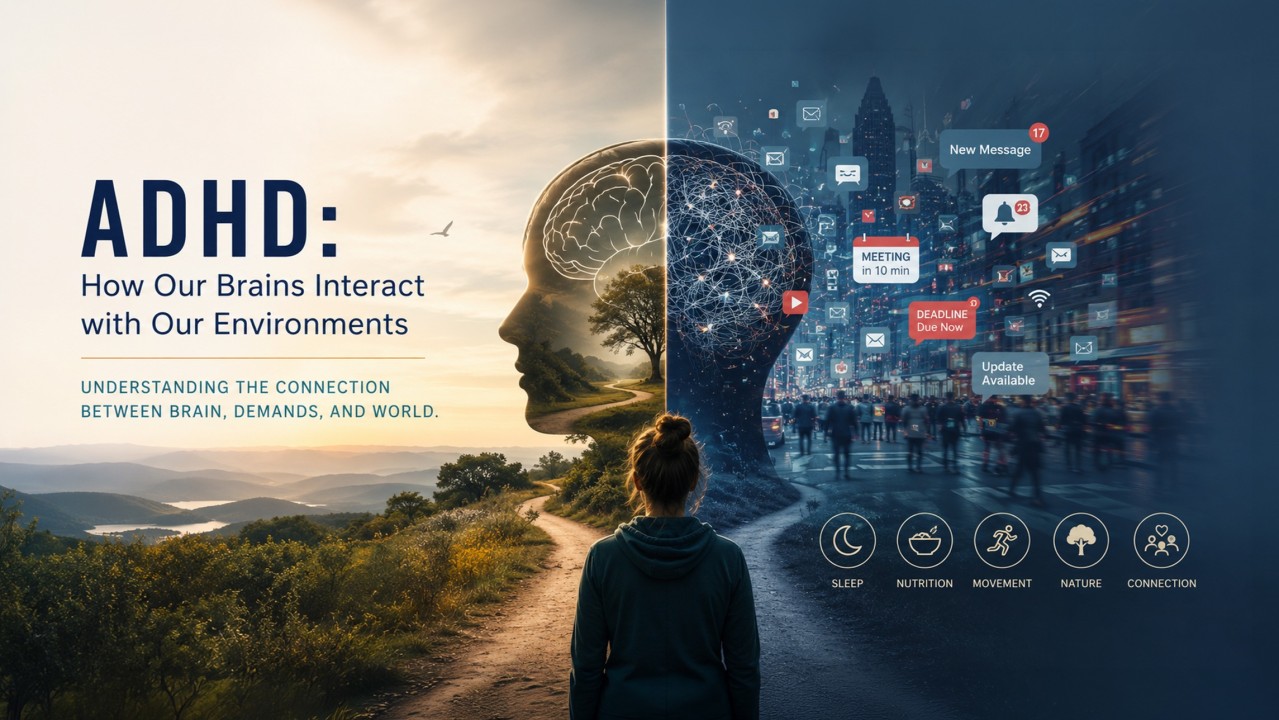
I believe much of the answer lies in the world we have created for ourselves.
Over the past few decades, our environment has changed dramatically. We now live surrounded by constant demands for our attention.
As I write this, emails and notifications appear in the corner of my screen, each one quietly asking me to stop what I’m doing and pay attention to something else. Part of my brain immediately wonders, “Maybe I should check — what if it’s important?”
So I look.
Then I return to writing, but now my thoughts feel scattered. I have to settle my mind again, remember where I was, and rebuild my focus.
The very world we have created works against the calm, sustained attention that so many of us need in order to function well.
I’ve spent years studying what helps reduce ADHD symptoms. The recommendations are familiar:
Get seven to eight hours of restorative sleep. Eat nutritious meals rather than relying on highly processed convenience foods. Exercise regularly. Spend time outdoors. Maintain close relationships. Slow down. Spend time in nature — which research suggests can help calm the mind and restore attention.
And the more I think about this ideal “ADHD-friendly lifestyle,” the more I realize something striking:
It looks remarkably similar to the way many people lived only a few generations ago.
People cooked more meals at home. Fast food was rare. Microwaves did not exist. The internet did not exist. There were no smartphones creating an expectation of constant availability. If someone called and you weren’t home, they simply called back later.
Children were told, “Go outside and play,” rather than spending every afternoon in structured activities while exhausted parents tried to juggle work, schedules, transportation, and household responsibilities.
In other words, many of the environmental supports that help ADHD brains function better were once built into everyday life.
I am not romanticizing the past.
Women’s opportunities were severely limited. Many women were financially dependent on men, and even educated women often found their career choices restricted to a narrow range of acceptable professions. We have gained enormously from women’s expanded opportunities.
But we also need to acknowledge something: the expectation that women could work full-time, remain the primary parent, manage the household, organize everyone’s lives, and somehow “do it all” was never realistic.
I know. I was one of those women trying to do it.
And I believe this impossible set of expectations helps explain why many younger women today are questioning the entire model — choosing to delay having children, have fewer children, remain child-free, or explore different ways of dividing work and family responsibilities.
Almost everyone seems to agree on one thing: the expectation that one person can do everything is unsustainable.
My ADHD brain has wandered a bit into “the good old days” and the impossible demands placed on women — so let me circle back.
This is exactly the point.
ADHD is always about the relationship between a brain and its environment.
As the late Dr. Thomas Brown often explained, ADHD difficulties emerge when the demands placed upon us exceed our ability to manage them.
A woman who has successfully compensated for her ADHD for years may suddenly feel overwhelmed after having a baby, when sleep deprivation, hormonal shifts, and nonstop responsibility exceed her coping capacity.
A bright young adult with ADHD may do well through college but struggle when faced with the open-ended, self-directed demands of completing a master’s thesis or doctoral dissertation.
The ADHD was always there — but intelligence, structure, support, and effort helped mask it. When environmental demands finally exceeded the ability to compensate, the ADHD became visible.
Today, more and more of us are living in environments that exceed our capacity to cope.
The constant interruptions. The endless decisions. The pressure to respond immediately. The devices designed to capture our attention.
For people lower on the ADHD continuum — those who managed reasonably well for years — today’s world may be the tipping point.
And younger generations, who have never known a world without digital distraction, may be especially vulnerable.
So why does there seem to be so much more ADHD today?
It’s the environment.
Understanding ADHD has always required us to look at the interaction between the brain and the world that brain is trying to function in.
Medication can be enormously helpful. Strategies and supports can change lives. But there is no pill powerful enough to completely overcome a 24/7 world built to interrupt us.
If we truly want to understand ADHD, we need to stop asking only, “What is different about this brain?”
We also need to ask:
“What kind of world are we asking this brain to live in?”
ILAT – the Institute for Lifespan ADHD Training – is under construction at this very moment, designed to help clinicians treating people with ADHD at every age to be more effective and holistic in their approach to ADHD treatment. Our first ILAT event will be the ILAT Global ADHD Summit, a two-day online event offering CEs on October 29 and 30.
To learn more and receive updates about the ILAT Global ADHD Clinical Training Summit, visit ILAT Global: https://ilatglobal.org
We look forward to seeing you there and hope you will join us in our evolving understanding of ADHD and how to live authentic, satisfying lives in this changing and challenging world we now live in.