
Years ago, a colleague of mine worked with a juvenile justice “diversion program” designed to redirect first-time offenders away from incarceration and toward counseling and support.
Most of these teenagers were boys. Most were Black and brown. The judge warned them: “If I see you in my courtroom again, you’re going in the slammer.”
After evaluating many of these young people, my colleague told me something striking: she believed at least 80% had ADHD.
The counselors assigned to them were undoubtedly well-intentioned. But how many had specialized training in ADHD? How many understood that these teens needed more than warnings, consequences, and lectures about making better choices?
Many likely continued along the school-to-prison pipeline — and later the prison-to-unemployment pipeline — returning to their communities with even fewer resources and fewer opportunities.
Recently, I listened to a discussion about mistrust of ADHD diagnosis in Black communities. The recommendation was that Black children showing signs of ADHD should receive a “comprehensive psychological evaluation.”
My reaction: How realistic is that?
Even affluent families struggle to find and afford these evaluations, which often cost $2,000–$4,500. For many families in underserved communities, this recommendation is not a pathway to help — it is a locked door.
With the best of intentions, we continue recommending solutions that many families cannot possibly access.
Here is the uncomfortable truth: when we require expensive evaluations before children can receive ADHD support, we create barriers that disproportionately harm the very children who most need help.
While adults debate documentation requirements, children continue to fail, lose confidence, get punished, and fall further behind.
Russell Barkley, PhD, one of the world’s leading ADHD authorities, has emphasized that comprehensive psychological testing is not required to diagnose ADHD. ADHD is a clinical diagnosis based on history, interviews, observations, and standardized rating scales. Testing has an important role — but it should not become the gatekeeper to care.
We need a different approach.
Remove unnecessary barriers. Train pediatricians and other front-line providers to identify ADHD using evidence-based clinical methods so children can receive help earlier.
Redesign classrooms for today’s brains and today’s world. Our educational system still rewards sitting still, staying quiet, tolerating boredom, and memorizing information — skills designed for another era.
Today’s students need creativity, problem-solving, digital literacy, financial literacy, collaboration, AI skills, and the ability to manage themselves in a rapidly changing world.
Executive functioning is not learned by being told to “try harder.” It is built through meaningful, engaging work that teaches planning, persistence, flexibility, and follow-through.
Educate the juvenile justice system about ADHD. We need judges, attorneys, and probation officers to understand delayed executive function development. The question is not simply, “Did this teenager know right from wrong?”
Many adolescents with ADHD know the rules. The challenge is pausing, regulating emotions, anticipating consequences, and making a better choice in the moment.
If we truly believe in diversion, we need to stop asking only:
“What did this child do wrong?”
And start asking:
“What support was missing — and how do we change the trajectory?”
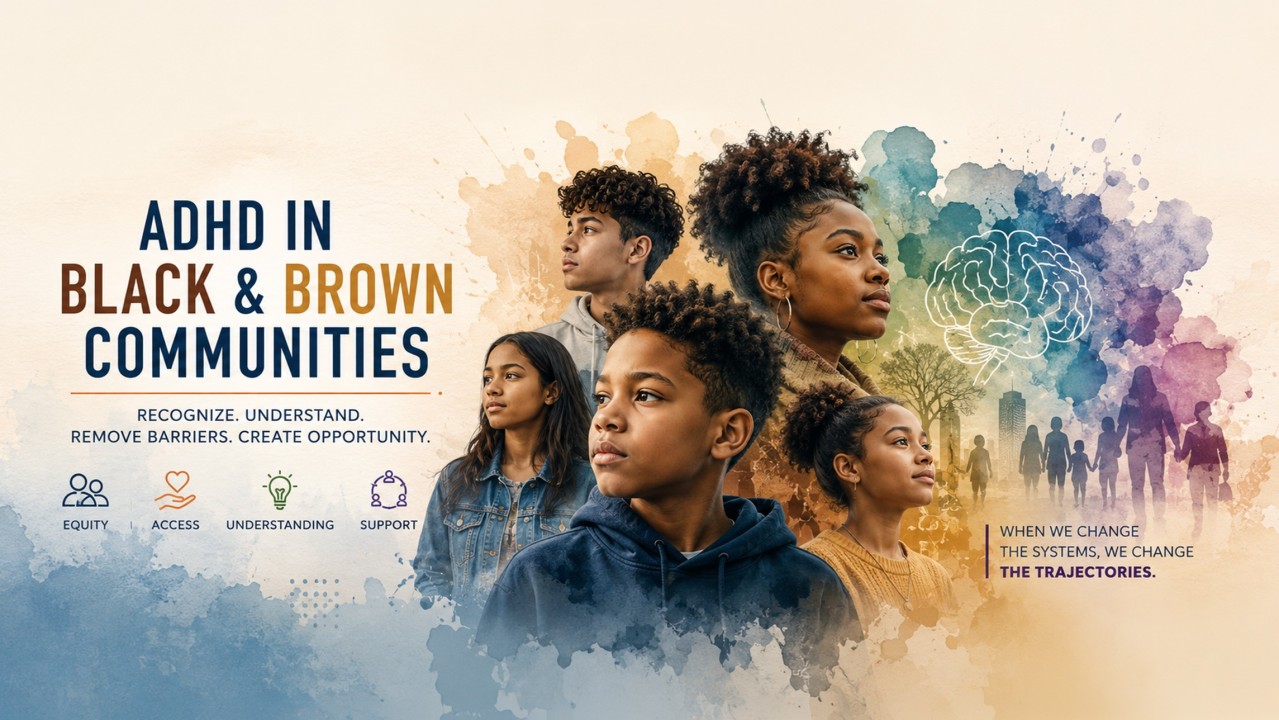
For too many Black and Brown children with ADHD, the greatest barrier is not that help does not exist. It is that we have built a system that makes help too difficult to reach.
The issues discussed in this article will also be explored at the ILAT Global ADHD Clinical Training Summit on October 29–30.
I am particularly looking forward to a panel discussion on underserved communities, stigma, and racial bias in ADHD, featuring Inger Shaye Colzie, Peter Fitts, and Tanya Murphy. Together, we will examine how cultural perceptions, systemic barriers, and inequities in healthcare, education, and the justice system influence ADHD recognition, diagnosis, and treatment.
These conversations are essential if we hope to move beyond awareness and toward meaningful change. Improving outcomes for Black and brown individuals with ADHD requires not only better clinical knowledge, but also a willingness to address the barriers that continue to prevent many from receiving the support they need.