
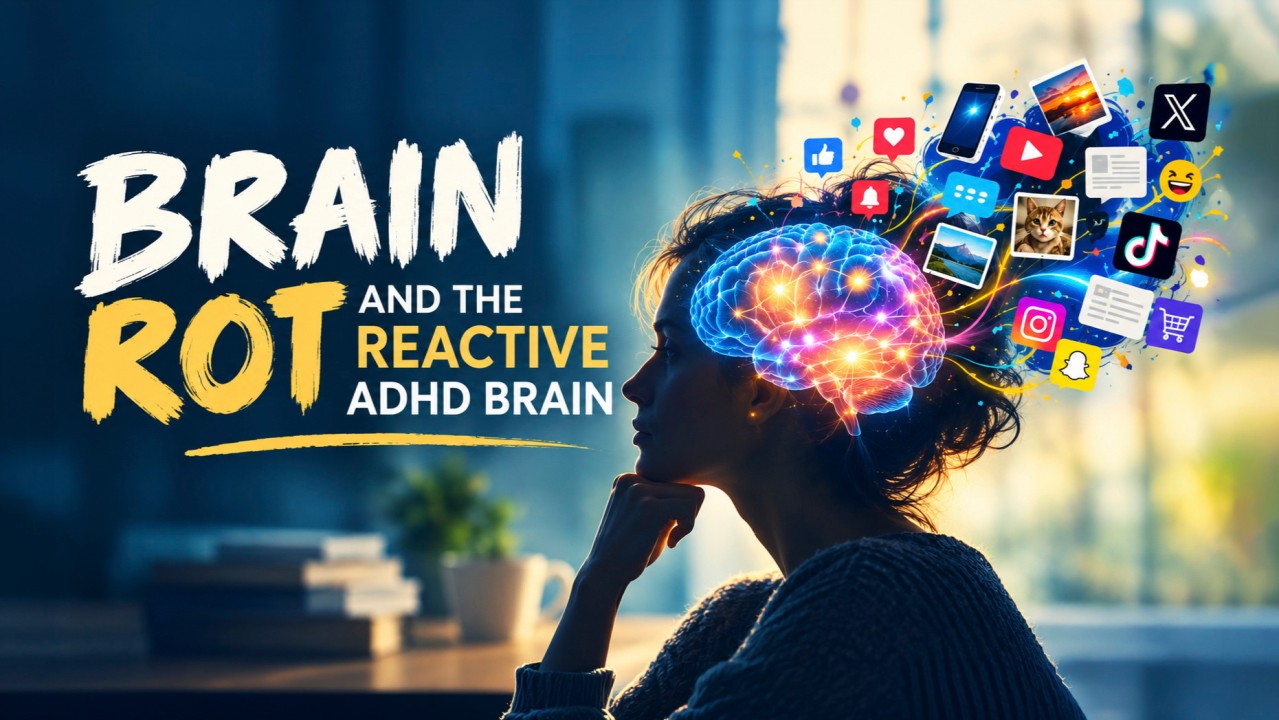
I have ADHD and as an ADHD specialist, I consider the observation of my own brain a built-in learning lab. Yes, we with ADHD come in many sizes and variations and I have the profound advantage that my decades-long career has focused on ADHD, which I have found endlessly engaging and fascinating. There is never a day I don’t read something that teaches me more about the complexity of human beings and how that complexity interfaces with this condition, this type of brain that we currently call ADHD.
One of the significant ADHD “markers” that my brain experiences is a constant flow of related and not-so-related thoughts. I remember as a child, loving the old nursery rhyme -“The world is so full of a number of things, I think we should all be as happy as kings.” – even then my brain was endlessly reacting to things internal and external. I recall my mother, a quiet and self-contained soul, remarking when I was a teenager that she didn’t understand how I thought of so many things to talk about. I responded to her that I didn’t understand how someone could run out of things to talk about because our brains are always thinking of something, which gives us endless potential topics. Not to mention that the world is happening all around us, giving us endless things to mention. My mother clearly curated her comments. In fact, when queried about something she didn’t care to discuss, her signature comment was, “Hmmm,” and when further queried, she would politely, but firmly suggest that we change the subject.
OK, so I’ve wandered down that garden path. Time for me to find the way to my topic of the day, “brain rot” and the ADHD brain. ADHD brains are reactive by nature – reacting to random thoughts inside our heads as well as to random comments, social media posts, the internet in general, or events around us. And that gets me to the concept of “brain rot,” as the state of endlessly reacting to random, usually meaningless images, memes, and other random things on the internet. When we don’t want to do what we need to do to keep our lives on track, the internet is always there, endlessly taking us down various garden paths, all in the name of profit. If they can catch our attention, they can soon catch our credit card, as things are algorithmically presented to us, custom-designed to tempt us because they’ve followed our breadcrumbs and know what’s on our mind.
I’m writing this article this morning, despite my original intention to write an article on back-to-school concerns of parents of children with ADHD. Why? Because I decided to “clear out my email” before beginning that article, and, lo and behold, I came across an article in the NY Times that interested me on “brain rot” which focused on the endless loops of meaningless interactions that so many of us these days get caught up in on the internet. I get caught up too, but my brain, thankfully, is interested in all manner of things, and especially interested in reading about how best to understand the human condition and the ADHD brain in particular, which typically loops me back to doing something meaningful related to my mission of educating clinicians about how to help those with ADHD to lead their best lives. (Is that a run-on sentence, or what?)
So, back to “brain rot,” defined as, “the perceived mental fatigue caused by spending too much time consuming trivial online content” a phrase that made it into the OED (Oxford English Dictionary), the official Bible of the English language) in June, 2025. So last year was the year of “brain rot.” I wonder what it will be this year? But back to brain rot and ADHD. There is a significant and growing body of research linking ADHD to brain rot in a bi-directional manner. First, that those of us with ADHD are more highly susceptible to brain rot because the ADHD brain craves stimulation and immediate gratification. And second, there is growing evidence that heavy social media and internet use is linked to a reduction in cortical thickness in brain regions responsible for analytical thinking, executive function, and inhibitory control, sort of “giving ourselves ADHD” through addictive doom-scrolling. Frightening, but not surprising. The fact is we build our brains analogously to how we build our muscles – by using certain brain functions over and over. Remember the study of the London cabbies (before GPS took over) who were required to memorize all the complex squiggles of boulevards, streets, bi-ways and highways of London that had been created willy-nilly over the centuries? The hippocampi of the cabbies were measurably larger. A later study showed that they had ¼ the likelihood of dying of Alzheimer’s than the average person in the UK because Alzheimer’s affects the hippocampus and theirs were highly developed. (Of note, they weren’t protected from vascular dementia which can occur throughout the brain and is not centered on the hippocampus.)
Another detour, here’s a hilarious illustration of what I’m writing about – I went online to search for mention of the research on London cabbies – quietly drinking my first cup of green tea for the day (in response to an article I recently read on regular green tea consumption being linked to longevity). I came across an article on the London cabbies in the Harvard Magazine, and as I read it, a huge, colorful, animated ad for KitKat bars popped up telling me to enjoy a KitKat bar in order to make my break more enjoyable. Not having a KitKat bar on hand, I’ve continued to sip my green tea – a big hint on how to break unwanted habits – who knows what might have happened had I had a KitKat bar in my kitchen pantry.
But back to my topic – what was it anyway – oh, yes – brain rotting and how we “grow” our brains for better or worse by the activities we engage in each day. So, here’s what research tells us about “brain rotting” and ADHD:
- Individuals diagnosed with ADHD are more vulnerable to “brain rot” because the algorithmic feeds on platforms such as TikTok or Instagram provide a highly addictive, continuous stream of dopamine hits that people with ADHD find very difficult to disengage from – think “Cognitive Junk Food” – intentionally addictive, undeniably unhealthy. To read the research: [1, 2, 3, 4, 5]
- A study by the Karolinska Institute and Oregon Health & Science University found a direct correlation between social media screen time and a sharp increase in inattention and ADHD symptoms over a 4-year period. The rapid context-switching required by infinite scrolling overloads the prefrontal cortex, creating cognitive fatigue and ADHD-like symptoms. For those kids already diagnosed with ADHD, significant social media time severely exacerbated their symptoms. To read the research: [1, 2, 3, 4]
- Frighteningly, researchers have found measurable brain alterations among heavy internet/social media users, specifically, a reduction in cortical thickness in areas of the brain (prefrontal lobe) responsible for analytical thinking, executive functioning, and control of impulses. In effect, when the brain is treated to constant, passive digital stimulation, it loses its capacity for deep, sustained attention. To read the research: [1, 2, 3, 4] In contrast, reading a book requires the deep, sustained concentration required for better prefrontal lobe functioning.
In effect, the corporate world has created a digital universe filled with cognitive junk food, initially appealing, clearly addictive, and changing our brains in very troubling ways. We all know brain rotting is bad for us, just as we know that potato chips are bad for us. We all know that brain rotting is initially engaging and relaxing, but ultimately deeply unsatisfying. And research is highlighting that these digital addictions are changing our brains in ways that make functioning well in the world increasingly more difficult.
So, what should we do about this cognitive junk food that makes ADHD worse and makes non-ADHD brains begin to resemble ADHD brains? I think it’s going to take a big and oft-repeated wake-up call, and ideally a call that is coming from the younger generation itself. If middle aged and older people (teachers, parents, grandparents) start wringing their hands and calling it a crisis, it will only broaden the generational divide. Telling young people to read more books and to stay off the internet will get you as far as I’ve gotten by teasing my husband by telling him to eat more kale – it just sends him back to his mac and cheese with even more determined attachment.
Cognitive junk food is isolating the younger generation and is changing their brains so that they are increasingly less able to focus, plan, follow through and create. As one young man was quoted as saying, “I’m scared I won’t find something I’m actually good at mainly because I don’t really have any hobbies. I guess brain rot is my hobby.”
The profit motive rules. We are intentionally being addicted to actual junk food and cognitive junk food, almost hypnotically trained to spend our money in certain ways. I don’t think it’s hopeless because I’ve seen the incredible societal shift in relation to cigarette smoking. But it’s going to take a massive effort. And all studies of habit change show us that habit substitution beats habit cessation every time. We need to help the younger generation actively form groups and develop anti-brain rot activities, not just tell them that doom scrolling or “death scrolling” as some call it, is bad for them. While less than ideal, I believe that interactive online groups playing digital games is much better for our brains and our mood than doom scrolling in isolation. And even better, how about a campaign to encourage people to actually get outside and interact with each other?
What about a Smoky the Bear campaign? Instead of “Only you can prevent forest fires,” how about an anti-doom scrolling icon saying “Only you can conquer doom scrolling! Talk to someone outside your room, outside your home, IRL at least three times a day!” We’ve got to get our brains out of the ADHD-enhancing digital world and back to the actual world.
This article was not sponsored by Nestlé or KitKat
Join the ILAT community to receive information about future events, programs, the ILAT Global Lifespan ADHD Summit, and other ILAT initiatives: www.ilat.org
Register for the ILAT Global Lifespan ADHD Clinical Training Summit: www.ilatglobal.org