
Let’s expand our skill set and get out of our silos: ADHD clinicians as active collaborative problem-solvers
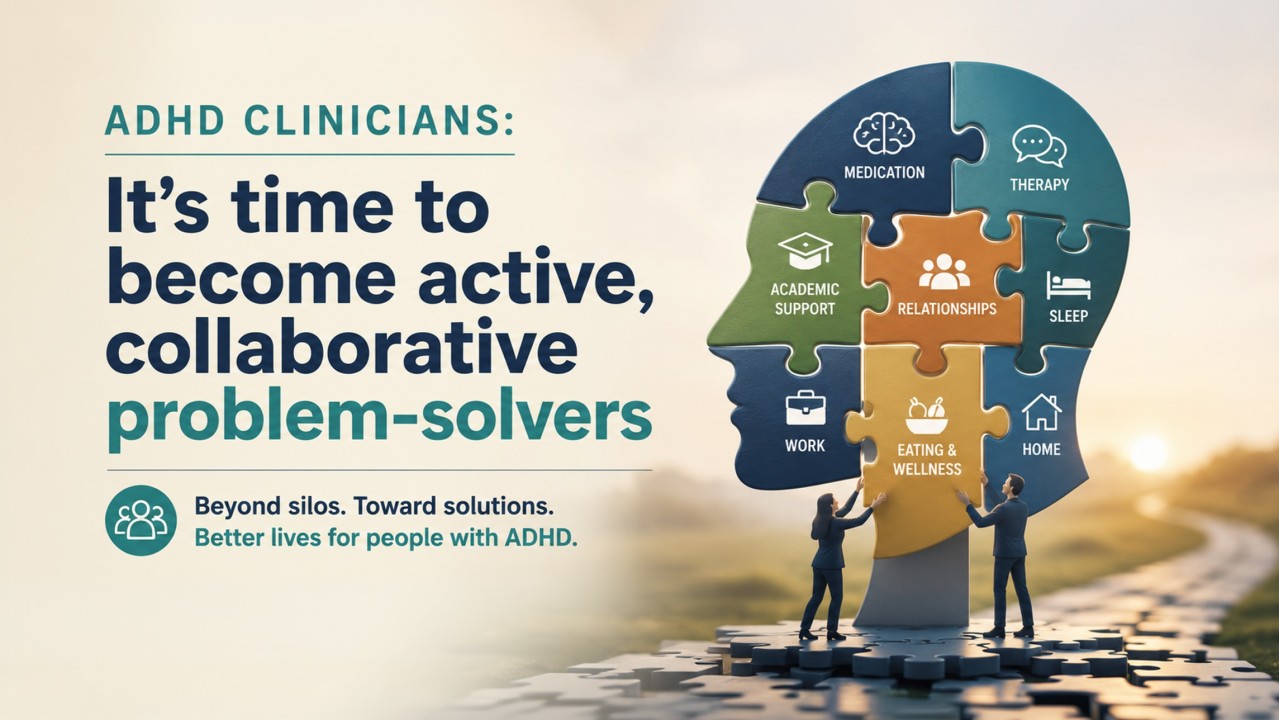
ADHD is complex, multifaceted, and deeply woven into every aspect of a person’s life. Yet the way we provide care is often fragmented. Too often, each professional addresses only one piece of the puzzle.
Need medication? You’re referred to a prescriber who may require another evaluation before treatment begins. Struggling with sleep? You’re sent to a sleep specialist who may focus primarily on ruling out sleep apnea. Binge eating? A referral is made to an eating disorder program that may have little training in ADHD. Struggling at work? Perhaps you are fortunate enough to find a career specialist who understands neurodiversity.
For children, the process can become even more complicated. A therapist may focus on parenting challenges, oppositional behavior, anxiety, or a young girl’s increasing school avoidance — all important concerns. But that same child may then need a neuropsychologist for testing, an educational specialist for learning challenges, a school advocate to obtain appropriate support, or a social skills group if social struggles emerge.
Each referral may be appropriate. Each specialist may be highly skilled.
But who is putting all the pieces together?
Too often, the adult with ADHD — or the overwhelmed parent of a child with ADHD — is forced to become the case manager, researching providers, coordinating recommendations, and trying to integrate conflicting advice. And for many families, especially outside major metropolitan areas, access to multiple ADHD-informed specialists is simply unavailable or unaffordable.
We need a different model.
Those of us who treat ADHD need to expand beyond our professional silos. It is natural to work from the framework in which we were trained. Psychotherapists may focus on anxiety, family dynamics, trauma, or emotional struggles. Prescribers may focus on medication management and ADHD symptom reduction. Educators may focus on classroom accommodations.
All of these are important.
But ADHD does not exist in separate compartments. ADHD happens in daily life.
It happens during the morning routine when a family starts every day in conflict. It happens when a child’s self-esteem erodes after years of school struggles. It happens when a bright adult repeatedly fails in a workplace that does not fit the way their brain functions.
As ADHD clinicians, we need to become active collaborative ADHD-informed problem-solvers. Because although ADHD knowledge is everywhere, knowing how to apply it is not. ILAT bridges that gap.
As active, collaborative, ADHD-informed problems solvers, clinicians should not only help clients cope with the emotional impact of their struggles — but help reduce the struggles themselves.
We need to help parents create more ADHD-friendly homes and rebuild positive relationships with their children. We need to understand school systems well enough to help families advocate for meaningful supports. We need to help adults examine their work environments and ask practical questions: Would a different schedule help? A different role? A different supervisor? A different workplace?
I often tell my clients:
“My job is to help you discover anything and everything that helps your brain function at its best.”
It is not medication versus lifestyle approaches. It is not therapy versus coaching. It is not changing the person versus changing the environment.
It is all of the above.
Sometimes the most powerful intervention is helping someone develop healthier daily habits. Sometimes it is helping parents thoughtfully create opportunities for their child to build friendships. Sometimes it is helping an adult recognize that the problem is not lack of effort — it is a poor match between their strengths and their environment.
Ultimately, successful ADHD treatment is about improving the fit between the individual and the world around them.
As therapists, many of us have been trained to help people manage stress. But we also need to learn how to help people change the conditions that are creating that stress.
This is the vision behind ILAT — the Institute for Lifespan ADHD Training. ADHD knowledge is everywhere. Knowing how to apply it is not. ILAT bridges that gap.
True expertise in ADHD care requires more than understanding symptoms.
It requires understanding lives.